
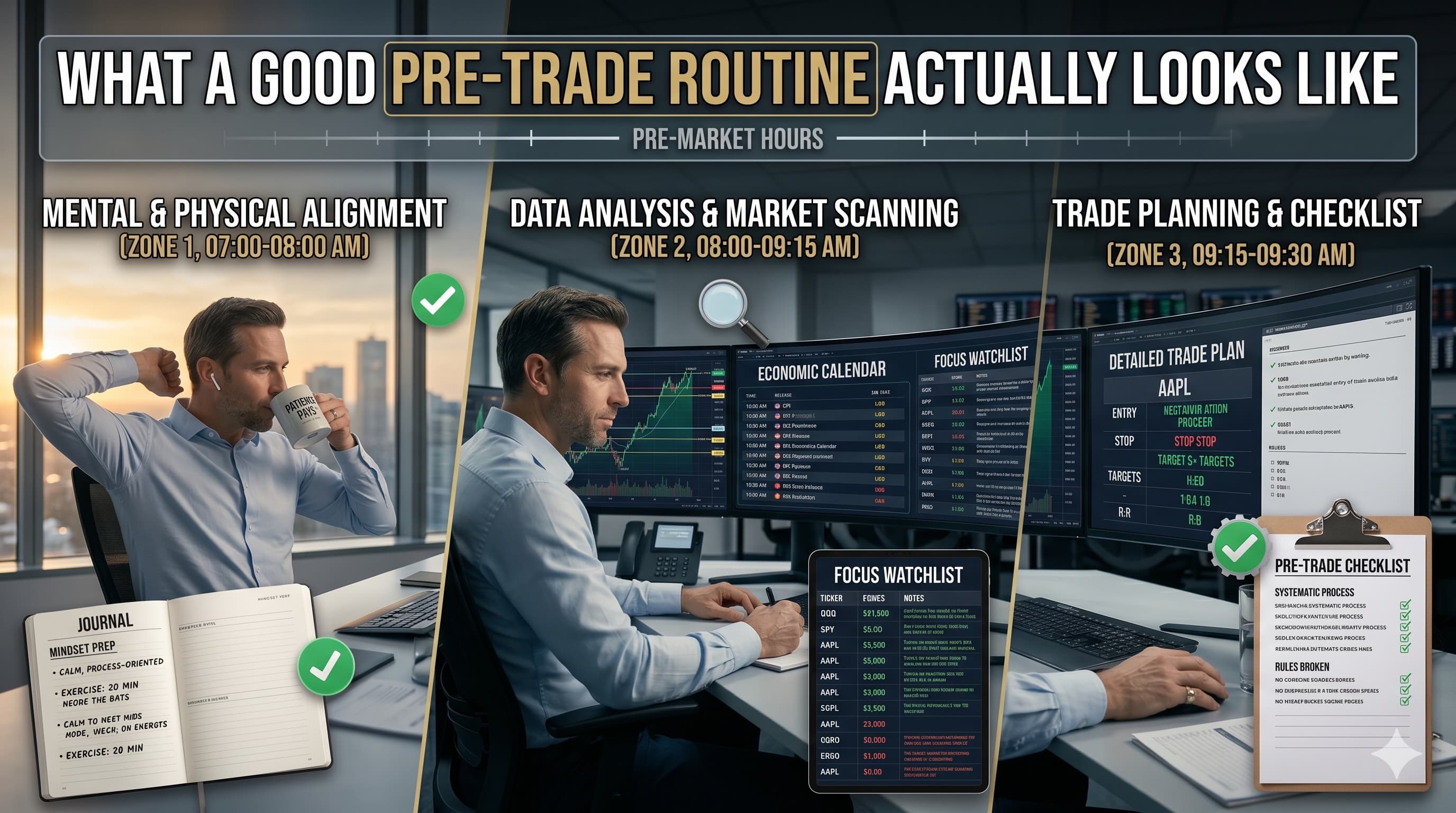
What a Good Pre-Trade Routine Actually Looks Like
What a Good Pre-Trade Routine Actually Looks Like
Many traders like the idea of a pre-trade routine.
It sounds professional. Structured. Disciplined.
But in practice, a lot of routines are either too vague to matter or too long to be useful.
They become another thing the trader does around trading rather than something that genuinely improves decisions.
A good pre-trade routine is not there to impress you.
It is there to make poor decisions less likely.
The real purpose of a routine
The purpose is not motivation.
It is not to hype yourself up, get into a peak state, or convince yourself that today will be different.
The real purpose is simpler:
- to narrow your attention
- to check whether the conditions fit your process
- to confirm your risk boundaries
- to notice whether your own mental state is stable enough to trade cleanly
That is it.
If your routine does not help with those things, it may feel useful without actually being useful.
Most traders either skip it or overload it
One common problem is having no routine at all.
The platform opens. Charts are scanned. The trader goes straight into reaction mode.
The other problem is the opposite.
The routine becomes a long sequence of market commentary, social media checks, news scrolling, multiple indicator reads, and half-focused observation that creates more noise than clarity.
Neither approach helps much.
A strong routine should make the market feel simpler, not more complicated.
What a solid pre-trade routine usually includes
For most discretionary traders, a good routine can stay very short.
It should answer a few key questions:
What conditions am I in?
Is the market trending, ranging, fast, slow, clean, messy, high conviction, or unclear?
What am I actually looking for today?
Which setup, which session, which instrument, which context?
What are my boundaries?
How much am I risking per trade? What is my stop for the day? What behaviour means I stop?
Am I in a stable state to trade?
Am I focused? Rushed? Frustrated from yesterday? Looking to prove something?
If those questions are answered clearly, you have already done most of the work a routine needs to do.
Short is usually better
Many traders assume a longer routine must be more serious.
Usually it is the opposite.
The longer the routine, the easier it becomes to drift into passive consumption and over-analysis. You feel engaged, but you are not getting clearer.
A useful routine often takes ten minutes or less.
It might include:
- checking higher-level market context
- identifying the specific setups you are willing to take
- reviewing your risk limits
- reading one short reminder about your common mistakes
- stepping away until your actual trading window begins
That is often enough.
Your routine should protect you from your known weaknesses
This is the part traders miss most often.
The best routine is not generic. It is personal.
If you know you overtrade after a quiet first hour, your routine should remind you that a slow start is not a problem.
If you know you size up after a strong day, your routine should explicitly reset position size.
If you know you take weaker setups when you feel behind, your routine should reinforce that there is no need to recover anything before the day has even started.
In other words, the routine should not just prepare you for the market.
It should prepare you for yourself.
Signs your routine is not doing its job
A pre-trade routine is probably too weak if:
- you still enter the session without a clear setup filter
- your risk feels negotiable once trading starts
- your emotional state is never checked honestly
- the routine changes every day depending on mood
- you cannot explain how it improves your actual execution
That does not mean you need something more complex.
It usually means you need something simpler and more specific.
Final thought
A good pre-trade routine does not need to feel elaborate.
It needs to be repeatable, honest, and useful under pressure.
If it helps you start the session with narrower focus, clearer risk, and better self-awareness, it is doing its job.
And if it does not, it is probably just ceremony.
In trading, useful structure matters far more than impressive structure.