
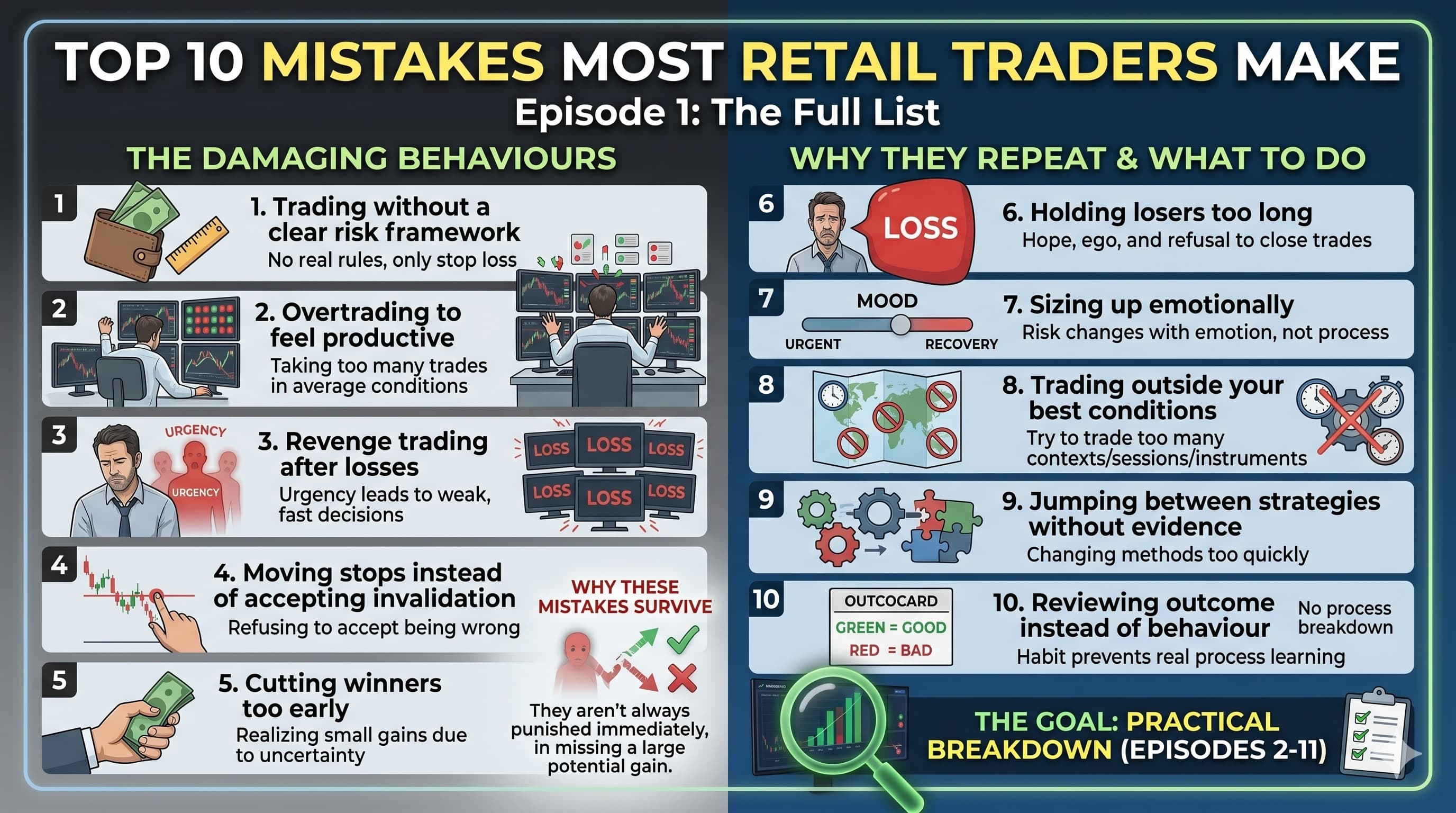
Top 10 Mistakes Most Retail Traders Make (Episode 1): The Full List
Top 10 Mistakes Most Retail Traders Make (Episode 1): The Full List
Most retail traders are not missing information.
They know they should manage risk. They know they should not revenge trade. They know they should be selective.
And yet the same damaging patterns keep repeating.
That is because trading problems are rarely caused by a single lack of knowledge. More often, they are caused by a small set of mistakes that show up again and again under pressure.
This series is about those mistakes.
Not in a dramatic, shame-based way.
In a practical way.
The goal is to identify the behaviours that quietly hold retail traders back and explain how to work on them with more structure and less guesswork.
The 10 mistakes that matter most
Here is the list the rest of this series will unpack in detail.
1. Trading without a clear risk framework
Many traders have a stop loss, but not a real risk framework. They know where a trade should fail, but not how much to risk, when to reduce size, or when the day should end.
2. Overtrading to feel productive
Activity feels like progress. That is why many traders take too many trades, especially in average conditions.
3. Revenge trading after losses
One loss turns into urgency. Urgency turns into speed. Speed turns into weak decisions.
4. Moving stops instead of accepting invalidation
What starts as "giving the trade a bit more room" often becomes refusal to accept that the idea was wrong.
5. Cutting winners too early
Many traders are more comfortable realising a small gain than sitting through the uncertainty required to let a good trade develop.
6. Holding losers too long
Hope, ego, and the desire to be right often keep traders in losing positions well past the point where the trade should have been closed.
7. Sizing up emotionally
Risk starts changing with mood. After wins, size increases because confidence rises. After losses, size increases because recovery feels urgent.
8. Trading outside your best conditions
Retail traders often try to trade too many sessions, too many instruments, or too many contexts before they have real evidence of edge there.
9. Jumping between strategies without evidence
When results feel unstable, many traders respond by changing methods too quickly instead of understanding what their current process is actually doing.
10. Reviewing outcome instead of behaviour
A green day gets labelled good. A red day gets labelled bad. That habit prevents real learning because process quality is never measured clearly enough.
Why these mistakes survive
Most of them survive for the same reason.
They are not always punished immediately.
Sometimes a trader breaks a rule and still makes money. Sometimes a weak trade works. Sometimes emotional sizing produces a big day.
That creates the illusion that the behaviour is acceptable.
But over time, these patterns damage consistency, confidence, and the ability to learn from real data.
What this series is meant to do
Over the next ten episodes, each of these mistakes will get its own full breakdown:
- what it looks like in real trading
- why it keeps happening
- what it costs
- how to work on it in a way that is actually practical
This is not about trying harder.
It is about getting more specific.
Because vague advice does not hold up well when money, emotion, and uncertainty are involved.
Final thought
Most retail traders do not need ten new indicators.
They need a clearer understanding of the ten behaviours that most often get in the way of decent performance.
That is the point of this series.
If a mistake keeps repeating, it is not just a frustrating habit.
It is a clue.
And if you learn to treat it properly, it can become one of the most useful sources of progress in your trading.