
When to Stop Trading for the Day
When to Stop Trading for the Day
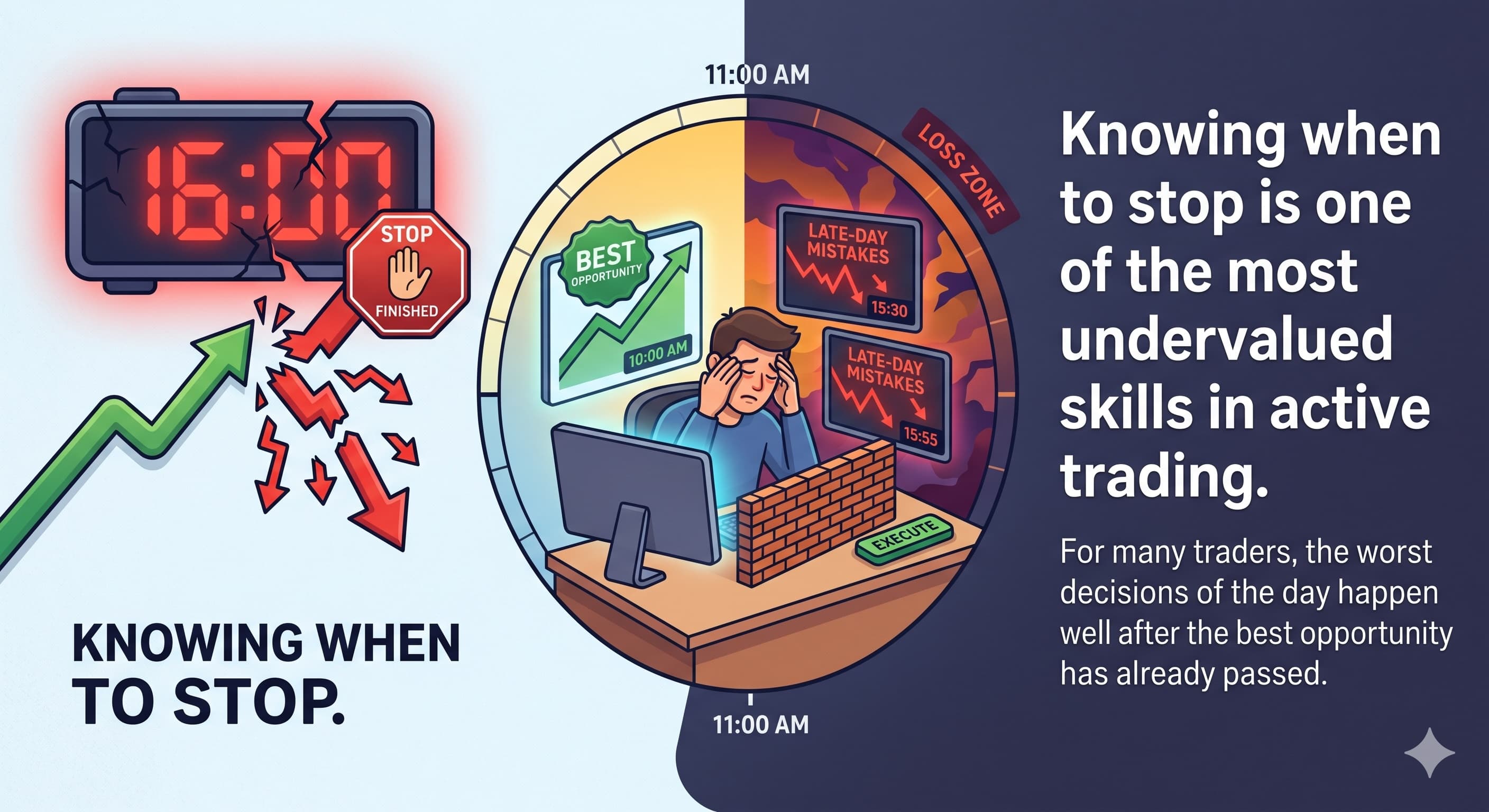
Knowing when to stop trading for the day is one of the most undervalued skills in active trading.
Most discussions about trading discipline focus on entries. What makes a setup valid. When to pull the trigger. How to manage a position.
But the decision to stop is just as important as the decision to enter.
And for a significant number of traders, poor end-of-day decisions are responsible for a large share of the damage in their overall results.
The problem with keeping the session open
There is an interesting dynamic that affects many active traders.
A trading session is treated as a fixed period that only ends at a certain time, or when the market closes. Until then, the trader keeps looking. Keeps watching for opportunities. Stays ready to act.
This feels like discipline. It looks like dedication.
But in practice, the longer a session stays open without a defined endpoint, the more likely the trader is to take trades under degraded conditions.
After two hours of focused analysis and clean execution, most traders are not in the same cognitive state as they were at the start. Decision quality shifts. Patience drops. The criteria used to evaluate setups becomes slightly more flexible. And none of this is noticed clearly because it happens gradually.
When most of the damage happens
This is worth examining with real data.
For many traders, the bulk of their losses are concentrated in a specific part of the day. Often it is the later portion of their session, after the primary opportunity window has closed.
The pattern often looks like this:
- the morning session goes well, or at least neutrally
- the main setups appear and are taken
- the day's real opportunity has largely passed
- the trader stays at the desk, waiting for something else
- a low-quality setup appears and gets taken
- that trade loses
- now the trader is slightly negative, or a small gain has been given back
- the urgency to recover creates a worse decision environment
- more trades follow
The session that started with clear thinking and good execution ends with trades that would never have been taken in the first hour.
Why stopping is so hard
Several forces push against the decision to stop.
Loss aversion. A trader who is down does not want to close the session with a loss. The drive to recover is strong, and stopping means accepting the loss as final for the day.
Opportunity anxiety. Even when nothing is setting up, there is a nagging feeling that something might appear. Closing the platform means possibly missing it.
Boredom. Trading is active. A quiet market does not demand action, but staying present with a quiet market is harder than it sounds.
Habit. Some traders simply stay at the desk because that is what they always do. There is no defined stopping condition, so stopping never feels like the right call.
What a clear stopping rule looks like
The most reliable way to address this is to define stopping conditions in advance, not in the moment.
Some traders use a profit-based stop. Once a daily target is hit, the session closes. This prevents good days from turning into average ones.
Some use a loss-based stop. A maximum daily loss amount, at which point the platform is closed regardless of the desire to recover. This is sometimes called a daily loss limit and is common in professional trading environments.
Some use a time-based stop. The session has defined start and end windows. Outside those windows, no trades are taken.
Some use a trade-count stop. After a certain number of trades in a session, no further entries are taken. This limits the exposure to low-quality, late-session setups.
No single rule works for every trader. But having a rule is almost always better than not having one.
The specific rule matters less than the commitment to follow it under pressure. Because the situations where stopping is hardest are exactly the situations where stopping matters most.
Reviewing your own stopping patterns
Most traders can identify their late-session mistakes if they look honestly at the data.
Pull your trades and look specifically at:
- which hour of the day your worst-performing trades were taken
- whether trades taken after a sequence of losses are better or worse than average
- whether your win rate holds up in the final part of your session or drops
The answers will usually be uncomfortable but clear.
Once you see the pattern, defining a stopping rule becomes less of a discipline question and more of a structural one. You are not trying to resist the urge to keep trading. You are removing the conditions that allow it to happen.
Final thought
The discipline to stop is not passive. It is an active choice to protect the work already done.
A day that has gone well deserves to stay that way.
A day that has gone badly does not automatically improve because you kept the session open longer.
Knowing when to stop is not giving up. It is one of the most professional decisions a trader can make.