
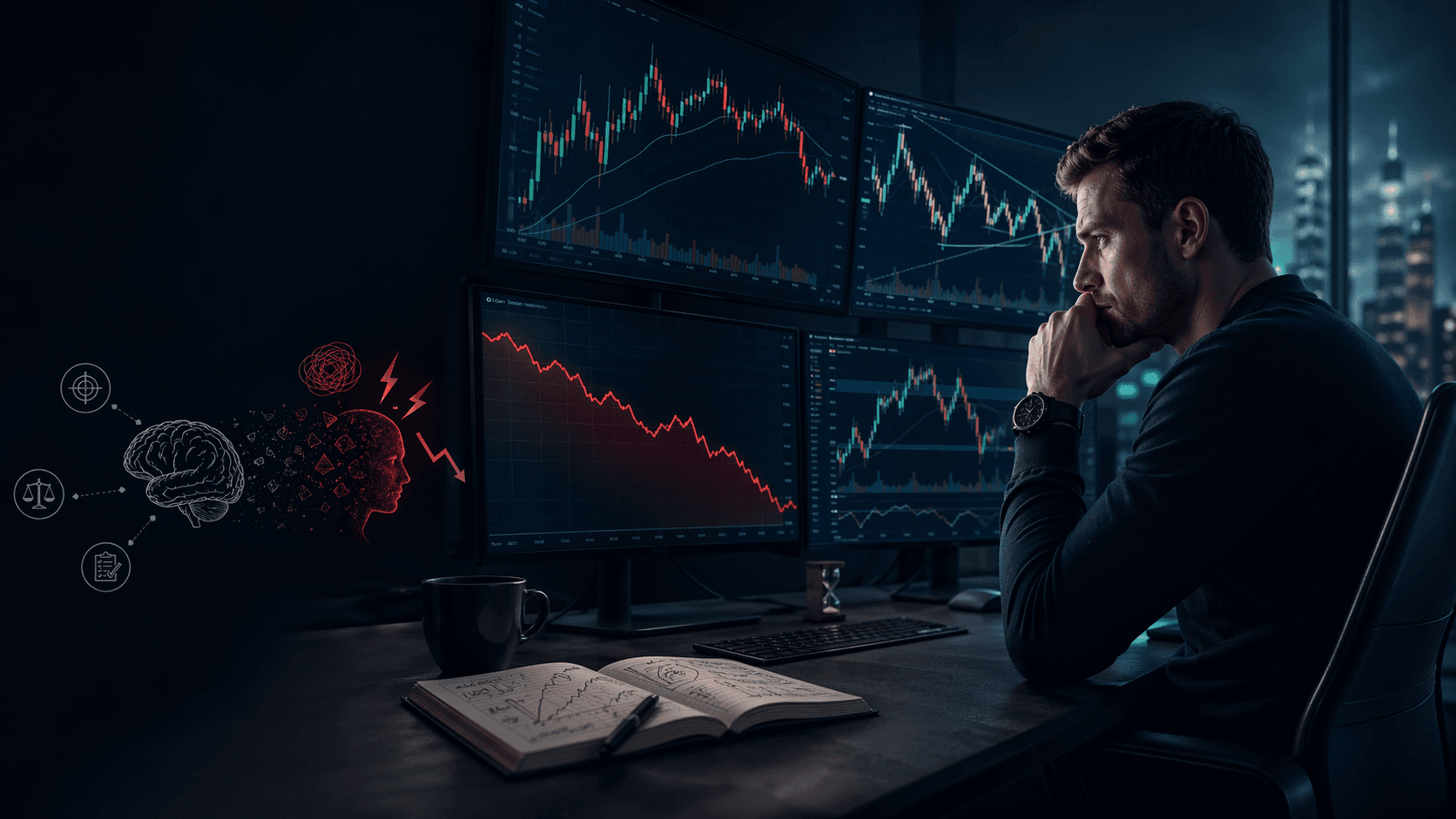
Why Good Traders Still Lose Money
Why Good Traders Still Lose Money
A lot of traders do not fail because they are lazy, unintelligent, or completely clueless.
In fact, many have already done the hard part. They have spent months or years studying charts, learning patterns, testing ideas, and getting real screen time. They understand support and resistance. They know what a clean setup looks like. They can explain risk-reward. They may even have had periods where they made solid money.
And yet, their results still feel inconsistent.
That is one of the most frustrating stages in trading.
You are no longer a beginner, but you are not getting the outcomes your experience should be producing. You know enough to see the mistakes, but not enough to stop repeating them.
The real problem is often not knowledge
At this stage, most traders think they need one more breakthrough:
- a better setup
- a sharper entry model
- another indicator
- a new mentor
- a more refined strategy
Sometimes that helps.
But very often, the real issue is simpler and harder to accept: you are trading without a proper feedback loop.
You are active in the market, but not learning from your own behaviour clearly enough.
What this looks like in practice
Many traders review their performance in a very shallow way.
They look at:
- whether the day was green or red
- total profit or loss
- win rate
- a few screenshots
- the trades they remember emotionally
The problem is that this rarely tells the full story.
A trader might think:
"My strategy stopped working."
But the truth might be:
- they traded worse after the first loss of the day
- they increased risk after two winners
- they performed badly only during one market session
- they kept cutting winners early
- they were profitable on one setup and consistently poor on another
- a small number of outsized losses destroyed otherwise decent execution
Without proper analysis, all of that gets blurred together.
So instead of fixing the real issue, the trader changes strategy, changes market, changes timeframe, or starts over again.
Why smart traders stay stuck
This is where many capable traders get trapped for years.
They are not clueless. They are just too close to their own trading to see it objectively.
Emotion also makes this worse.
Losses feel bigger than they are. A few bad days can make a trader believe everything is broken. A few good days can create false confidence. Memory becomes selective. The brain starts building stories that are not fully supported by the data.
That is dangerous, because in trading, vague self-assessment leads to vague improvements.
And vague improvements rarely change results.
The shift that actually helps
Progress starts when your review process becomes specific.
Instead of asking:
"Why am I losing?"
You start asking:
- Which setups actually make money for me?
- Which setups do I only think I trade well?
- When do I break my own rules most often?
- What happens after a losing streak?
- What happens after a winning streak?
- Which times of day produce my best trades?
- Are my biggest losses coming from bad analysis, bad discipline, or bad risk control?
- Am I letting one bad decision wipe out five good ones?
Those questions are far more useful than simply checking whether the week ended green or red.
Good trading review should lead to rules
A strong review process should not just tell you what happened.
It should help you produce clear actions.
For example:
- "I do not open a second trade within 10 minutes of a loss."
- "I reduce size after two losing trades in a session."
- "I only trade my A-grade setup during London open."
- "I take partials at a fixed level instead of reacting emotionally."
- "I stop trading for the day after hitting my daily risk limit."
That is where improvement happens.
Not in vague motivation.
Not in consuming more content.
Not in endlessly switching strategy.
It happens when insight becomes a rule, and a rule becomes a habit.
The traders who improve fastest are usually not the busiest
They are not always the ones taking the most trades.
They are usually the ones who understand themselves better.
They know:
- where they make money
- where they leak money
- how their behaviour changes under pressure
- what must be repeated
- what must be removed
That level of clarity creates confidence.
And importantly, it creates confidence based on evidence, not hope.
This is exactly why PnLPulse exists
PnLPulse is built for traders who want more than a basic journal.
It is for traders who want to import their history, understand what is really happening in their performance, identify patterns in behaviour and execution, and turn those insights into practical rules they can actually follow.
Because most traders do not need more noise.
They need clearer feedback.
They need to know what is working, what is not, and what to do next.
Final thought
If you have been trading for a while and still feel like you are going in circles, that does not automatically mean you lack ability.
It may simply mean your trading is generating lessons faster than your current review process can capture them.
That gap is where inconsistency lives.
Close that gap, and improvement becomes much more realistic.
Your next level in trading may not come from finding a new strategy.
It may come from finally understanding your current one, and understanding yourself within it.