
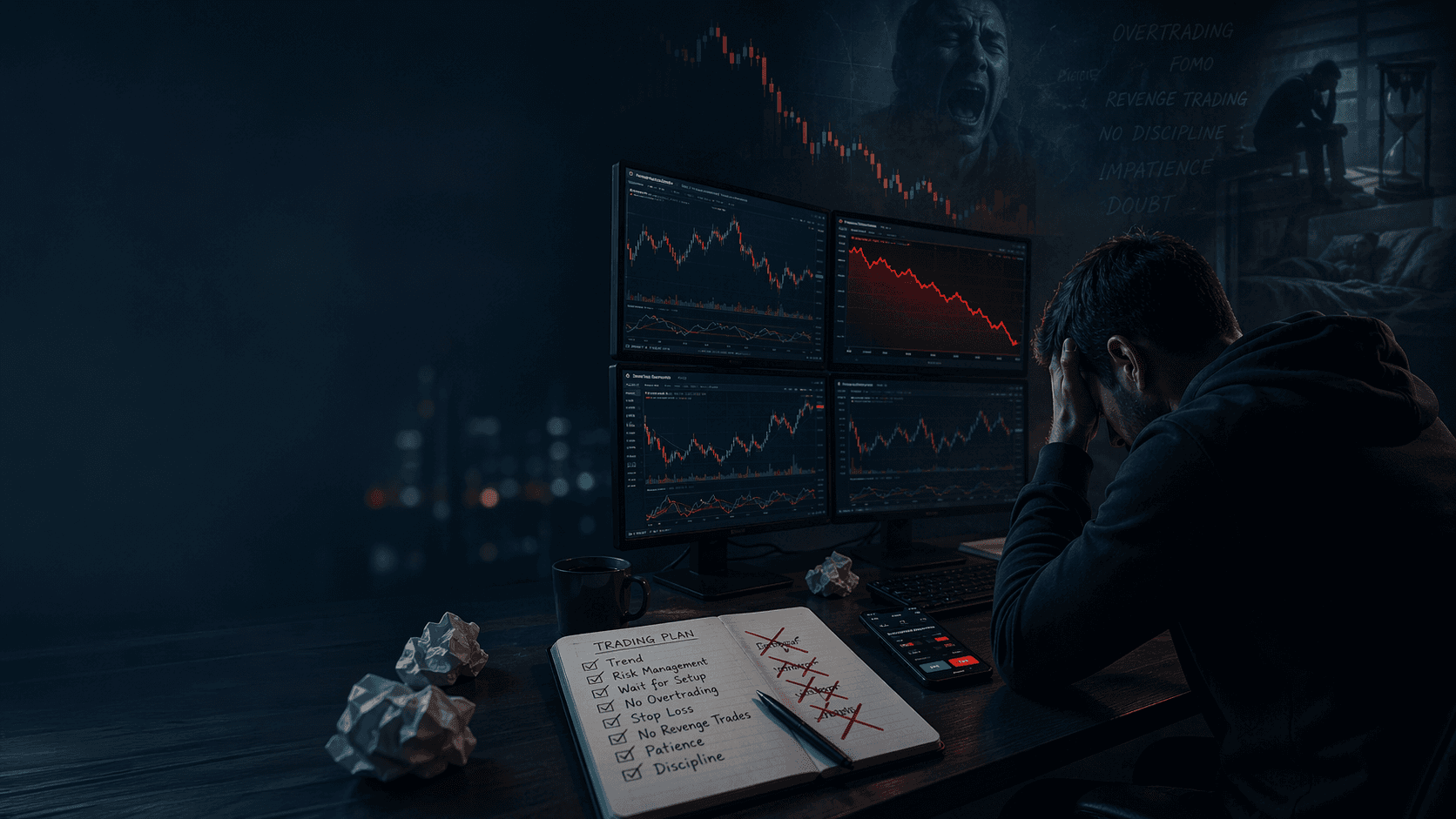
The Hidden Cost of Breaking Your Trading Rules
The Hidden Cost of Breaking Your Trading Rules
Most traders know the feeling.
You take a trade you should not have taken.
You size up when you said you would stay consistent.
You revenge trade after a loss.
You move a stop that should have been left alone.
Sometimes you get away with it.
And that is exactly why rule-breaking becomes so dangerous.
Because the real damage is not always the money you lose on that one trade.
Very often, the bigger damage is what it teaches your mind to tolerate.
Rule-breaking is rarely just one bad decision
Many traders think of discipline in simple terms.
They assume:
- a good trade means they were disciplined
- a bad trade means they were undisciplined
But trading is not that clean.
A bad trade can still follow your process.
A winning trade can still be a poor decision.
That is why judging yourself only by profit and loss creates problems.
If you break your rules and make money, your brain gets rewarded for bad behaviour.
If you follow your rules and lose, your brain may wrongly label discipline as failure.
Over time, this can completely distort your judgement.
The real cost starts with trust
Good trading depends heavily on self-trust.
Not blind confidence.
Not ego.
Not optimism.
Real self-trust means knowing that when market pressure rises, you are still likely to act within your own framework.
When you repeatedly break rules, that trust weakens.
You start to wonder:
- Will I actually stick to my stop?
- Will I overtrade after a red morning?
- Will I take a weak setup out of boredom?
- Will I ignore size limits when I feel confident?
That uncertainty is exhausting.
And once trust in your own execution drops, hesitation often increases as well.
Now you are not only battling the market.
You are battling your own inconsistency.
One broken rule often creates three more
This is what makes discipline leaks compound quickly.
A trader breaks one rule and enters a poor trade.
Then:
- they move the stop because the entry was weak
- they hold too long because they want to be right
- they re-enter after the loss because they feel frustrated
- they increase size because they want to recover quickly
So the original mistake is no longer just one bad entry.
It becomes a chain reaction.
This is why many red days feel worse than they should.
The first mistake was manageable.
The behaviour that followed made it expensive.
The emotional toll is easy to underestimate
Breaking your rules does not only affect your account.
It affects your state of mind.
Even when the financial damage is limited, the emotional effect can linger:
- frustration
- guilt
- anger
- overthinking
- reduced confidence the next day
- fear of pulling the trigger on valid setups
Many traders carry that into future sessions without fully realising it.
Then they start trading differently, not because the market changed, but because their emotional state changed.
That is how one moment of poor discipline can quietly affect an entire week.
Discipline is not about perfection
This is important.
No serious trader follows their rules perfectly all the time.
The goal is not to become robotic.
The goal is to reduce avoidable damage and tighten your behaviour over time.
That starts with honesty.
Instead of saying:
"The market was messy today."
Sometimes the more useful truth is:
"I was messy today."
That is not self-criticism for the sake of it.
It is how you separate strategy problems from execution problems.
And that distinction matters.
Because if the strategy is fine but the execution is poor, changing strategy will not solve anything.
A useful question to ask after every session
At the end of a trading day, many traders ask:
"Did I make money?"
That matters, but it is not enough.
A better question is:
"Did I trade in a way I would be happy to repeat tomorrow?"
That question is powerful because it shifts focus away from short-term outcome and towards repeatable behaviour.
You want to build a process that deserves repetition.
Not just celebrate the trades that happened to work.
How to reduce rule-breaking in practice
Improving discipline usually has less to do with motivation and more to do with structure.
Useful examples include:
- defining exactly what counts as a valid setup
- setting a maximum number of trades per session
- using fixed daily loss limits
- reducing size after emotional disruption
- pausing after a large win or a large loss
- reviewing not just losing trades, but also rule-breaking winning trades
That last one is especially important.
A rule-breaking winner is often more dangerous than a rule-breaking loser, because it reinforces the wrong lesson.
This is where performance tracking becomes valuable
Most traders already know their rules in theory.
The problem is seeing clearly where and how they actually drift from them.
That is where proper review matters.
You need to know:
- when rule-breaking happens most
- what triggers it
- how expensive it becomes over time
- whether it appears after wins, losses, boredom, or overconfidence
Because once you can see the pattern, you can start interrupting it.
Final thought
A broken trading rule rarely costs only the amount lost on that trade.
It also affects trust, consistency, emotional control, and the quality of decisions that follow.
That is why discipline matters so much.
Not because traders need to be perfect, but because repeated rule-breaking quietly turns manageable problems into major ones.
Protect your rules, and you protect far more than a single position.
You protect the trader you are becoming.